

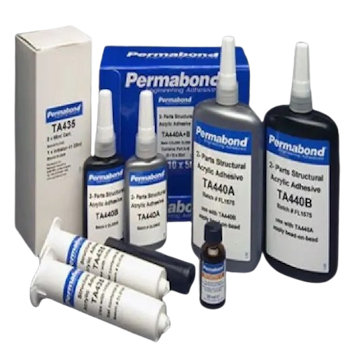

- Manufacturer: PERMABOND


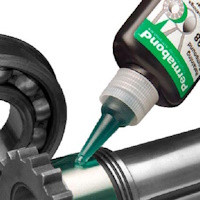


Cyanoacrylate adhesives (CA) are low viscosity, high purity, single-component adhesives designed for bonding difficult materials such as rubber and plastics. They are especially suitable for EPDM, natural and butyl rubber, as well as many plastics and metals where surfaces fit closely.
These adhesives are also known as instant or super glues and are widely used for fast repair and precision industrial bonding.
Cyanoacrylate adhesives are 100% reactive and solvent-free, requiring no mixing or heating. They polymerize very quickly when compressed into a thin layer between surfaces. Moisture on the surface initiates curing, allowing initial bonding within seconds.
Applications
• Rubber (EPDM, NBR, natural rubber)
• Plastics (ABS, PVC, etc.)
• Metals
• Sealing profiles and gaskets
• Small components and repair parts
Key advantages
• Extremely fast curing
• High bonding strength
• Low viscosity for tight-fitting surfaces
• No mixing required
• Clean and precise application
Usage
Surfaces must be clean, dry and degreased using acetone or isopropanol. Apply a small amount on one surface, join parts quickly and press firmly to distribute the adhesive in a thin layer. Do not move until sufficient strength is achieved.
Excess adhesive can be removed using CA solvent, nitromethane or acetone if compatible. For porous or difficult surfaces, use an activator. For PP, PE, PTFE or silicone, use a primer.
Additional information
Cyanoacrylate adhesives are widely used in manufacturing, maintenance, sealing and repair applications where fast and reliable bonding is required.
Frequently asked questions
What are cyanoacrylate adhesives?
Fast-curing adhesives that bond surfaces within seconds.
What is the difference between instant and super glue?
They are the same type of adhesive, different naming.
Where are cyanoacrylates used?
Rubber, plastics, metals, sealing and industrial repair.
Is an activator required?
Not always, but recommended for difficult surfaces.